

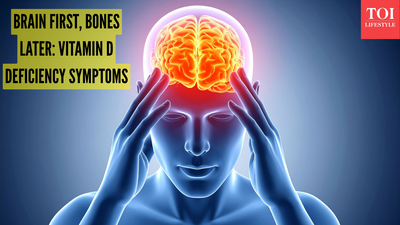
Vitamin D Deficiency: It all starts in the brain, not in bones: The first and foremost sign of vitamin D deficiency |
Most people, sometimes even healthcare practitioners, think that the first signs of vitamin D deficiency are weak bones, muscle pain, and fatigue. For years, vitamin D deficiency has been closely associated with bone strength and muscle weakness. However, Dr. Eric Berg, a wellness expert, explains how the earliest signs of low vitamin D rarely appear in the bones. They appear in the brain long before you notice any physical discomfort.Many people experience mood swings, sudden anxiety, irritability, or low motivation, and they assume it is simply stress or something emotional, or just in our “brains”. But these changes can be your body’s way of signaling that vitamin D levels are slipping or are surprisingly low in your body. This is surprising to many because they have never connected vitamin D to mental health. Yet recent research and wellness experts show just how deeply this nutrient affects the brain.
Mood changes are often the very first sign: Remember, it all starts in the brain

Dr. Berg points out that the brain has a high concentration of vitamin D receptors. These receptors influence the production of serotonin, which is the chemical responsible for regulating mood and emotional balance. When vitamin D levels fall, serotonin production also drops. This can show up as irritability, mood swings, sadness, anxious thoughts, or a general feeling of being emotionally overwhelmed.For many people, these symptoms appear suddenly, without any major life change or trigger, which makes them even more confusing. They try breathing exercises, lifestyle changes, or even therapy, yet the emotional shifts continue because the root cause may be purely nutritional.
Why the brain reacts before the bones

Physical symptoms of vitamin D deficiency take time to develop and are silent. Bones become weak slowly, and muscle aches often appear after months or years of deficiency. The brain, however, reacts quickly to a lack of essential nutrients. That is why mental and emotional symptoms appear first.Several lifestyle factors worsen the problem. Most people spend long hours indoors with limited sunlight exposure. Stress is also common, and high stress levels can interfere with the natural metabolism of vitamin D. Sleep issues and poor diet further contribute to the problem. When all of these come together, the deficiency becomes more pronounced and the emotional symptoms intensify.
Other early symptoms linked to low vitamin D

Although mood shifts are the most noticeable early sign, they are not the only ones. Many people with low vitamin D experience issues such as:
- Difficulty concentrating
- Brain fog
- Constant fatigue
- Low motivation
- Trouble sleeping
- Feeling overwhelmed easily
These symptoms are so common in modern life that most people overlook them entirely. They assume it is a natural part of stress, work pressure, or a busy schedule, not realizing that vitamin D may be the underlying factor.
Blood tests are not always accurate indicators
One thing Dr. Berg highlights is that standard blood tests can show “normal” levels even when the body is still deficient. This happens because vitamin D must be activated inside the cells. If the body is low in magnesium or has inflammation, the vitamin may not be properly converted into its active form.This means a person can have normal test results but still experience symptoms because the cells themselves are not receiving enough vitamin D. That is why listening to your symptoms is important.
How vitamin D affects more than mood
Vitamin D is involved in hundreds of processes in the body. It strengthens the immune system, regulates hormones, influences inflammation, supports heart health, and helps muscles function properly. When levels are low, these systems begin to function less efficiently.This is why early detection is so important. Correcting vitamin D levels early can prevent long-term issues such as chronic fatigue, weakened immunity, bone loss, and metabolic problems.
How to restore vitamin D naturally

Improving vitamin D levels does not require drastic changes. Simple daily habits can make a big difference:
- Spend 10-15 minutes daily in sunlight
- Use vitamin D3 supplements
- For max benefits, pair vitamin D with magnesium and K2
- Eat foods like eggs, fatty fish, mushrooms, and fortified dairy
- Support gut health, since the gut is involved in absorbing nutrients
var _mfq = window._mfq || [];
_mfq.push([“setVariable”, “toi_titan”, window.location.href]);
!(function(f, b, e, v, n, t, s) {
function loadFBEvents(isFBCampaignActive) {
if (!isFBCampaignActive) {
return;
}
(function(f, b, e, v, n, t, s) {
if (f.fbq) return;
n = f.fbq = function() {
n.callMethod ? n.callMethod(…arguments) : n.queue.push(arguments);
};
if (!f._fbq) f._fbq = n;
n.push = n;
n.loaded = !0;
n.version = ‘2.0’;
n.queue = [];
t = b.createElement(e);
t.async = !0;
t.defer = !0;
t.src = v;
s = b.getElementsByTagName(e)[0];
s.parentNode.insertBefore(t, s);
})(f, b, e, ‘https://connect.facebook.net/en_US/fbevents.js’, n, t, s);
fbq(‘init’, ‘593671331875494’);
fbq(‘track’, ‘PageView’);
};
function loadGtagEvents(isGoogleCampaignActive) {
if (!isGoogleCampaignActive) {
return;
}
var id = document.getElementById(‘toi-plus-google-campaign’);
if (id) {
return;
}
(function(f, b, e, v, n, t, s) {
t = b.createElement(e);
t.async = !0;
t.defer = !0;
t.src = v;
t.id = ‘toi-plus-google-campaign’;
s = b.getElementsByTagName(e)[0];
s.parentNode.insertBefore(t, s);
})(f, b, e, ‘https://www.googletagmanager.com/gtag/js?id=AW-877820074’, n, t, s);
};
function loadSurvicateJs(allowedSurvicateSections = []){
const section = window.location.pathname.split(‘/’)[1]
const isHomePageAllowed = window.location.pathname === ‘/’ && allowedSurvicateSections.includes(‘homepage’)
const ifAllowedOnAllPages = allowedSurvicateSections && allowedSurvicateSections.includes(‘all’);
if(allowedSurvicateSections.includes(section) || isHomePageAllowed || ifAllowedOnAllPages){
(function(w) {
function setAttributes() {
var prime_user_status = window.isPrime ? ‘paid’ : ‘free’ ;
var geoLocation = window?.geoinfo?.CountryCode ? window?.geoinfo?.CountryCode : ‘IN’ ;
w._sva.setVisitorTraits({
toi_user_subscription_status : prime_user_status,
toi_user_geolocation : geoLocation
});
}
if (w._sva && w._sva.setVisitorTraits) {
setAttributes();
} else {
w.addEventListener(“SurvicateReady”, setAttributes);
}
var s = document.createElement(‘script’);
s.src=”https://survey.survicate.com/workspaces/0be6ae9845d14a7c8ff08a7a00bd9b21/web_surveys.js”;
s.async = true;
var e = document.getElementsByTagName(‘script’)[0];
e.parentNode.insertBefore(s, e);
})(window);
}
}
window.TimesApps = window.TimesApps || {};
var TimesApps = window.TimesApps;
TimesApps.toiPlusEvents = function(config) {
var isConfigAvailable = “toiplus_site_settings” in f && “isFBCampaignActive” in f.toiplus_site_settings && “isGoogleCampaignActive” in f.toiplus_site_settings;
var isPrimeUser = window.isPrime;
var isPrimeUserLayout = window.isPrimeUserLayout;
if (isConfigAvailable && !isPrimeUser) {
loadGtagEvents(f.toiplus_site_settings.isGoogleCampaignActive);
loadFBEvents(f.toiplus_site_settings.isFBCampaignActive);
loadSurvicateJs(f.toiplus_site_settings.allowedSurvicateSections);
} else {
var JarvisUrl=”https://jarvis.indiatimes.com/v1/feeds/toi_plus/site_settings/643526e21443833f0c454615?db_env=published”;
window.getFromClient(JarvisUrl, function(config){
if (config) {
const allowedSectionSuricate = (isPrimeUserLayout) ? config?.allowedSurvicatePrimeSections : config?.allowedSurvicateSections
loadGtagEvents(config?.isGoogleCampaignActive);
loadFBEvents(config?.isFBCampaignActive);
loadSurvicateJs(allowedSectionSuricate);
}
})
}
};
})(
window,
document,
‘script’,
);
Source link
Your point of view caught my eye and was very interesting. Thanks. I have a question for you. https://accounts.binance.com/es-AR/register-person?ref=UT2YTZSU
Thank you for your sharing. I am worried that I lack creative ideas. It is your article that makes me full of hope. Thank you. But, I have a question, can you help me? https://accounts.binance.com/register-person?ref=IHJUI7TF
Your article helped me a lot, is there any more related content? Thanks! https://www.binance.info/bg/register?ref=V2H9AFPY
I don’t think the title of your article matches the content lol. Just kidding, mainly because I had some doubts after reading the article.
Can you be more specific about the content of your article? After reading it, I still have some doubts. Hope you can help me.
I don’t think the title of your article matches the content lol. Just kidding, mainly because I had some doubts after reading the article.
Your article helped me a lot, is there any more related content? Thanks!
Can you be more specific about the content of your article? After reading it, I still have some doubts. Hope you can help me.
I don’t think the title of your article matches the content lol. Just kidding, mainly because I had some doubts after reading the article. https://www.binance.com/en-ZA/register?ref=B4EPR6J0
Your article helped me a lot, is there any more related content? Thanks! https://accounts.binance.com/pt-PT/register-person?ref=KDN7HDOR
Can you be more specific about the content of your article? After reading it, I still have some doubts. Hope you can help me. https://www.binance.com/ES_la/register?ref=VDVEQ78S
Thanks for sharing. I read many of your blog posts, cool, your blog is very good. https://accounts.binance.com/ru-UA/register?ref=JVDCDCK4
Your point of view caught my eye and was very interesting. Thanks. I have a question for you.
Thanks for sharing. I read many of your blog posts, cool, your blog is very good.
I don’t think the title of your article matches the content lol. Just kidding, mainly because I had some doubts after reading the article. https://accounts.binance.info/sl/register-person?ref=I3OM7SCZ
Your article helped me a lot, is there any more related content? Thanks!
Your point of view caught my eye and was very interesting. Thanks. I have a question for you. https://accounts.binance.com/register-person?ref=IXBIAFVY
Can you be more specific about the content of your article? After reading it, I still have some doubts. Hope you can help me.
Thanks for sharing. I read many of your blog posts, cool, your blog is very good.
I don’t think the title of your article matches the content lol. Just kidding, mainly because I had some doubts after reading the article.
I don’t think the title of your article matches the content lol. Just kidding, mainly because I had some doubts after reading the article.
Your point of view caught my eye and was very interesting. Thanks. I have a question for you.
Can you be more specific about the content of your article? After reading it, I still have some doubts. Hope you can help me.
Can you be more specific about the content of your article? After reading it, I still have some doubts. Hope you can help me.
Can you be more specific about the content of your article? After reading it, I still have some doubts. Hope you can help me. https://www.binance.com/si-LK/register?ref=LBF8F65G
Your point of view caught my eye and was very interesting. Thanks. I have a question for you.
Can you be more specific about the content of your article? After reading it, I still have some doubts. Hope you can help me.
Your point of view caught my eye and was very interesting. Thanks. I have a question for you.
Can you be more specific about the content of your article? After reading it, I still have some doubts. Hope you can help me. https://www.binance.com/ru/register?ref=O9XES6KU
Can you be more specific about the content of your article? After reading it, I still have some doubts. Hope you can help me.
Your point of view caught my eye and was very interesting. Thanks. I have a question for you.
Can you be more specific about the content of your article? After reading it, I still have some doubts. Hope you can help me.
Your article helped me a lot, is there any more related content? Thanks!
Thank you for your sharing. I am worried that I lack creative ideas. It is your article that makes me full of hope. Thank you. But, I have a question, can you help me? https://accounts.binance.com/register-person?ref=QCGZMHR6
Can you be more specific about the content of your article? After reading it, I still have some doubts. Hope you can help me.
I don’t think the title of your article matches the content lol. Just kidding, mainly because I had some doubts after reading the article.
Can you be more specific about the content of your article? After reading it, I still have some doubts. Hope you can help me. https://www.binance.com/register?ref=IXBIAFVY
Your article helped me a lot, is there any more related content? Thanks!
Can you be more specific about the content of your article? After reading it, I still have some doubts. Hope you can help me.
Your article helped me a lot, is there any more related content? Thanks!
Your article helped me a lot, is there any more related content? Thanks!
Your article helped me a lot, is there any more related content? Thanks!
Thanks for sharing. I read many of your blog posts, cool, your blog is very good.
I don’t think the title of your article matches the content lol. Just kidding, mainly because I had some doubts after reading the article.
Your point of view caught my eye and was very interesting. Thanks. I have a question for you.
I don’t think the title of your article matches the content lol. Just kidding, mainly because I had some doubts after reading the article.
I don’t think the title of your article matches the content lol. Just kidding, mainly because I had some doubts after reading the article.
Thank you for your sharing. I am worried that I lack creative ideas. It is your article that makes me full of hope. Thank you. But, I have a question, can you help me? https://accounts.binance.com/register-person?ref=JW3W4Y3A
Can you be more specific about the content of your article? After reading it, I still have some doubts. Hope you can help me.
Your point of view caught my eye and was very interesting. Thanks. I have a question for you.
Thank you for your sharing. I am worried that I lack creative ideas. It is your article that makes me full of hope. Thank you. But, I have a question, can you help me?
Thanks for sharing. I read many of your blog posts, cool, your blog is very good.
I don’t think the title of your article matches the content lol. Just kidding, mainly because I had some doubts after reading the article. https://www.binance.com/register?ref=JW3W4Y3A
Your article helped me a lot, is there any more related content? Thanks! https://www.binance.com/register?ref=JW3W4Y3A
Thank you for your sharing. I am worried that I lack creative ideas. It is your article that makes me full of hope. Thank you. But, I have a question, can you help me?
Thank you for your sharing. I am worried that I lack creative ideas. It is your article that makes me full of hope. Thank you. But, I have a question, can you help me?
Your article helped me a lot, is there any more related content? Thanks!
Can you be more specific about the content of your article? After reading it, I still have some doubts. Hope you can help me. https://accounts.binance.info/sl/register?ref=I3OM7SCZ
Can you be more specific about the content of your article? After reading it, I still have some doubts. Hope you can help me.
Thanks for sharing. I read many of your blog posts, cool, your blog is very good.
Thanks for sharing. I read many of your blog posts, cool, your blog is very good. https://www.binance.com/register?ref=QCGZMHR6
I don’t think the title of your article matches the content lol. Just kidding, mainly because I had some doubts after reading the article.
Your point of view caught my eye and was very interesting. Thanks. I have a question for you. https://accounts.binance.bh/sk/register?ref=WKAGBF7Y
I don’t think the title of your article matches the content lol. Just kidding, mainly because I had some doubts after reading the article.
Your point of view caught my eye and was very interesting. Thanks. I have a question for you.
Your point of view caught my eye and was very interesting. Thanks. I have a question for you.
Thank you for your sharing. I am worried that I lack creative ideas. It is your article that makes me full of hope. Thank you. But, I have a question, can you help me? https://accounts.binance.bh/register/person?ref=IHJUI7TF
Can you be more specific about the content of your article? After reading it, I still have some doubts. Hope you can help me.
Your point of view caught my eye and was very interesting. Thanks. I have a question for you.
I don’t think the title of your article matches the content lol. Just kidding, mainly because I had some doubts after reading the article. https://accounts.binance.info/register/person?ref=JW3W4Y3A
Thanks for sharing. I read many of your blog posts, cool, your blog is very good.
Thank you for your sharing. I am worried that I lack creative ideas. It is your article that makes me full of hope. Thank you. But, I have a question, can you help me?
I don’t think the title of your article matches the content lol. Just kidding, mainly because I had some doubts after reading the article.
Your point of view caught my eye and was very interesting. Thanks. I have a question for you.
Your point of view caught my eye and was very interesting. Thanks. I have a question for you.
Your point of view caught my eye and was very interesting. Thanks. I have a question for you. https://accounts.binance.bh/register/person?ref=QCGZMHR6
Thank you for your sharing. I am worried that I lack creative ideas. It is your article that makes me full of hope. Thank you. But, I have a question, can you help me?
Thanks for sharing. I read many of your blog posts, cool, your blog is very good.
Your article helped me a lot, is there any more related content? Thanks!
Thanks for keeping things clear and to the point, that is honestly hard to find online these days, and after reading through firstisnotequallast the message stayed consistent which makes me trust the information being shared more than I usually do on similar pages that cover this same kind of topic.
Thank you for your sharing. I am worried that I lack creative ideas. It is your article that makes me full of hope. Thank you. But, I have a question, can you help me? https://accounts.binance.com/register/person?ref=IHJUI7TF
I don’t think the title of your article matches the content lol. Just kidding, mainly because I had some doubts after reading the article.
Can you be more specific about the content of your article? After reading it, I still have some doubts. Hope you can help me. https://www.binance.com/register?ref=IHJUI7TF
Thanks for sharing. I read many of your blog posts, cool, your blog is very good.
Thanks for sharing. I read many of your blog posts, cool, your blog is very good. https://www.binance.bh/register?ref=GGYHGRE
You took a subject that could have gone dull and filled it with such life that I never once wanted to look away from it. This handed me the room to slow down and think and that unexpected stillness was exactly the thing I had been missing. Whatever fuels writing this genuine please guard it fiercely because it is producing work that truly helps real people.
The perspective you offered here reframed something I thought I had fully grasped and made it feel fresh once again. You have a talent for catching the small forgotten truth and gently raising it into the light for everyone to notice. May your creativity keep flowing without end because readers like me lean on writers like you to stay brave and hopeful.
I felt my mind grow quieter as I read because your steady patient tone made the whole subject feel entirely within reach. The calm confidence in your writing convinced me that the road you sketch is one that a person like me could truly walk. Thank you once more for showing that small honest steps eventually gather into the exact changes we all quietly hope for.
The sincerity woven through this whole piece is exactly the kind of thing that keeps my hope in honest writing alive. The way you moved me easily from one thought to the next made the whole piece feel like one seamless flowing idea. Never doubt how far your words travel because this single post has already lifted at least one grateful stranger today.
Thank you for your sharing. I am worried that I lack creative ideas. It is your article that makes me full of hope. Thank you. But, I have a question, can you help me?
Thank you for your sharing. I am worried that I lack creative ideas. It is your article that makes me full of hope. Thank you. But, I have a question, can you help me?