

Indian Cobra Facts: 7 facts about the Indian cobra that explain why it’s so misunderstood
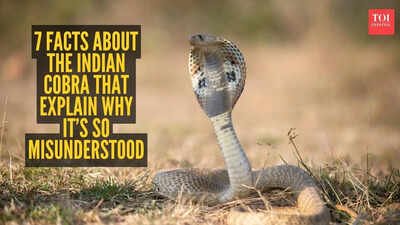
A hood, a split-second pause, and a question that usually follows: “Was that a cobra?” That’s often how encounters begin in India – with doubt that quickly turns into distance being created. The Indian cobra is so familiar in name that people assume they know it well. The reality is a little more layered and far more interesting.Here are some lesser-known facts about the Indian cobra that go beyond the usual fear-driven image.
It doesn’t always live where you expect it to
The Indian cobra is often imagined as a deep-forest species. In reality, it is far more flexible. It turns up in agricultural fields, storage rooms, construction sites, and even quiet corners of residential areas.
The hood is not “always there” – it’s a switch, not a feature
Most people picture a cobra as constantly hooded. That’s not how it works.The hood appears only when the snake feels threatened. It’s created by extending the ribs in its neck region, flattening the skin outward. Outside of that moment, the cobra looks far less dramatic.In many sightings, people don’t even realize what they saw until it has already moved away.
It doesn’t chase – it avoids
One of the most misunderstood things about cobras is behaviour. Despite its reputation, the Indian cobra is not a chasing predator when it comes to humans.It prefers to avoid confrontation. Most bites happen in accidental situations – when it is stepped on, surprised, or trapped without an exit path. Before anything defensive happens, it usually tries to create space first.That’s also why many encounters end without incident if people simply step back.
It has a “silent control” role in everyday life
Cobras feed heavily on rodents – rats, mice, and similar small animals. That alone makes them more important in everyday ecosystems than most people realize.In farming areas, this becomes especially relevant. Rodents are one of the biggest reasons for crop loss and grain damage. The cobra, quietly, is part of keeping that balance in check.
The way it “looks at you” is actually a survival tactic
People often describe a cobra as staring or tracking movement. What’s actually happening is far more practical than expressive.Cobras rely heavily on detecting motion rather than detailed vision. That fixed, steady posture is part of how they assess threats and decide whether to stay still or retreat.What looks like “attention” is actually calculation.
It sits in culture, not just in forests
Unlike many wild animals, the cobra exists strongly in cultural memory. It appears in temple carvings, mythology, and rituals like Nag Panchami, where it is both respected and feared.This dual identity is rare – it is one of the few wild species that people don’t just avoid, but also symbolically acknowledge.
It is dangerous, but not unpredictable
The Indian cobra is venomous, and medically significant bites require urgent treatment. But its behaviour is not random.It usually gives clear warning signals first – hood spreading, still posture, hissing – before any defensive action. Those moments are less aggression and more communication in its own way.Thumb image: Canva (for representative purposes only)

Generally I don’t read post on blogs, but I wish to say that this write-up very forced me to try and do it! Your writing style has been surprised me. Thanks, quite nice post.