

2026 Honda City review: The smart sedan strikes back
For the past few years, the midsize sedan conversation has revolved largely around two cars: the Volkswagen Virtus and the Skoda Slavia. Between their turbocharged engines, European driving manners and strong enthusiast appeal, they have become the default recommendations in the segment.
The Honda City, meanwhile, had quietly gone about its business. That may be about to change. With its refreshed design, expanded feature list and, most importantly, a strong-hybrid powertrain that combines genuine performance with exceptional fuel efficiency, the 2026 Honda City presents perhaps the most compelling all-round package in the segment.
After spending a day driving it around Bengaluru’s outskirts, including highways, country roads and the winding climb towards Nandi Hills, it became clear that Honda’s enduring sedan still has plenty of fight left in it.
The spacious cabin continues to be one of the City’s biggest strengths, offering comfort for both driver and passengers.
| Photo Credit:
Special Arrangement
Honda has approached this update with admirable restraint. Rather than reinventing the City, the company has focused on refining a formula that has served it well for over two decades. The changes are immediately apparent, particularly at the front, where slimmer Blade-Eye LED headlamps, a connected light bar and a cleaner grille design give the sedan a more contemporary look. There are clear influences from Honda’s larger global sedans in the way the front fascia has been executed, lending the City a more premium presence than before.
At 4,594 mm in length, the City remains one of the largest sedans in its class, and its proportions continue to work beautifully. While some rivals have embraced increasingly dramatic styling in an effort to stand out, the City relies on clean lines, balanced proportions and understated sophistication. The redesigned alloy wheel designs and refreshed detailing inject just enough youthfulness into the package without compromising the maturity that has always been part of the City’s appeal.
Step inside and it becomes immediately apparent that Honda still understands one of the fundamental reasons people buy sedans. Space. The City continues to offer one of the most accommodating cabins in the segment, with generous legroom, excellent shoulder room and seating that remains comfortable over long journeys. Four adults can travel in complete comfort, and the sense of openness inside the cabin is genuinely impressive. In some respects, it rivals what you would expect from entry-level luxury sedans costing significantly more.
The cabin itself has aged gracefully. The ivory-and-black interior theme creates a light and airy ambience, while new trim elements, ambient lighting and the larger touchscreen help modernise the experience. The feature list is comprehensive, with ventilated front seats, wireless charging, wireless Apple CarPlay and Android Auto, rear AC vents, USB-C charging ports and a 360-degree camera all contributing to an experience that feels thoroughly up to date. While the camera’s resolution could be better, it performs its intended function adequately and is unlikely to be a deal-breaker at this price point.
If there is one area where the City does not quite lead the segment, it is the infotainment display. Although the display is larger than before and easy to use, some rivals offer sharper graphics, faster response times and a more premium user interface.
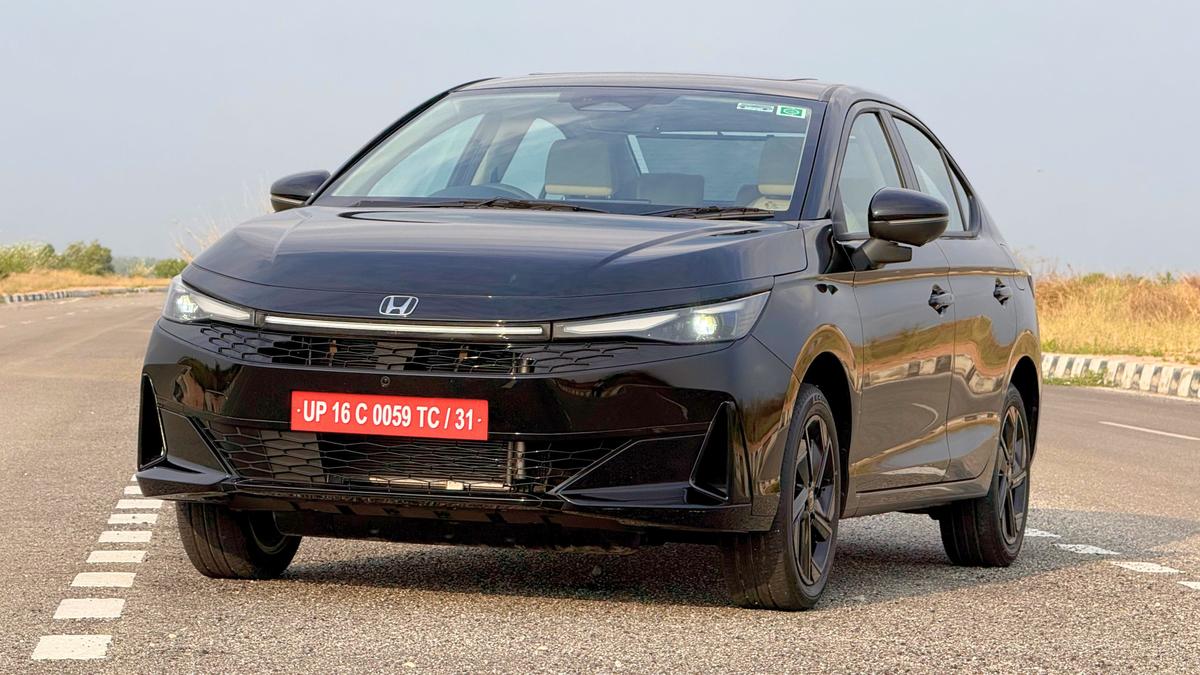
Honda’s strong-hybrid powertrain combines impressive performance with exceptional real-world fuel efficiency.
| Photo Credit:
Special Arrangement
Functionally, it works extremely well, offering seamless connectivity and an intuitive interface. However, visually it lacks the sharpness and sophistication of some newer systems. It is a minor shortcoming in an otherwise excellent cabin, and one that most owners are unlikely to dwell on. The air-conditioning system, meanwhile, deserves praise. Throughout a full day of driving in varying conditions, the system kept the cabin comfortably cool and reinforced the premium feel that runs throughout the car.
Practicality has always been one of the City’s strongest attributes and that remains true today. The petrol variants offer a generous 506 litres of boot space, while the hybrid sacrifices a small amount of capacity to accommodate its battery pack. Even so, luggage space remains more than adequate for family duties, weekend getaways and airport runs.
While the design and cabin updates are welcome, the most significant change to the City’s character comes from what sits beneath the bonnet. Honda’s self-charging strong-hybrid system combines a 1.5-litre Atkinson-cycle i-VTEC petrol engine with two electric motors and a lithium-ion battery pack to produce a combined 126 PS and 253 Nm of torque. Those numbers tell only part of the story.
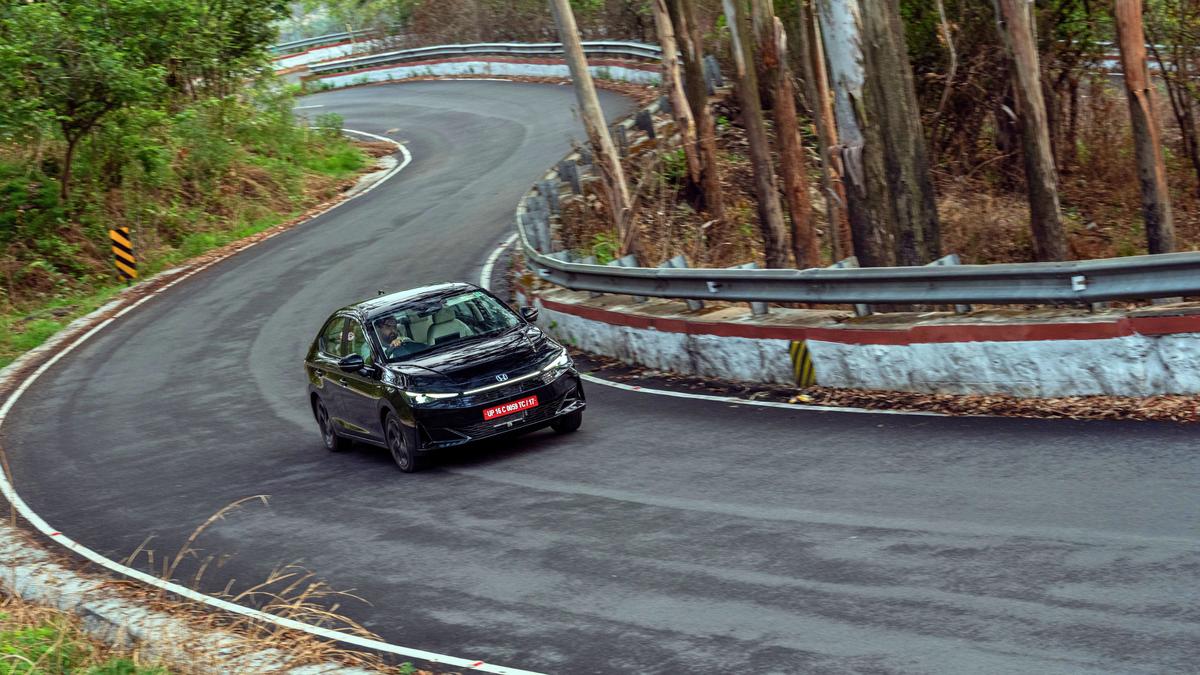
Ride quality remains a standout, with the City delivering impressive composure over a variety of road surfaces.
| Photo Credit:
Special Arrangement
The City has always been refined, but the hybrid introduces a level of responsiveness that fundamentally changes the way the car feels to drive. Instant electric torque gives the sedan a sense of effortless performance that conventional petrol rivals struggle to match. Whether accelerating away from a junction, overtaking slower traffic on a two-lane highway or climbing towards Nandi Hills, the City always feels eager to move forward. There is a surprising amount of pep in the way it responds to throttle inputs, and it is clear that Honda has consciously worked to make the City feel younger and more engaging than before.
Hybrid cars are often unfairly associated with uninspiring driving experiences, but that stereotype does not apply here. With a claimed 0-100 km/h time of 7.9 seconds, the City is genuinely quick by segment standards. No, it doesn’t deliver the explosive mid-range punch of the turbocharged Virtus GT or Slavia 1.5 TSI when driven flat-out, but in everyday conditions it feels responsive, smooth and effortlessly capable. More importantly, it delivers its performance with a level of refinement that few rivals can match.
Refinement has long been one of Honda’s defining strengths, and it shines throughout the driving experience. The transitions between EV, Hybrid and Engine Drive modes are virtually imperceptible, engine noise is well controlled and vibrations are kept to a minimum. The result is a sedan that feels sophisticated and expensive, regardless of whether it is crawling through traffic or cruising at highway speeds.
What impressed me most, however, was the ride quality. Over broken roads, highway expansion joints and uneven country roads, the City displayed a level of composure that genuinely exceeded expectations. The suspension absorbs imperfections with remarkable maturity while maintaining excellent body control, creating an experience that feels smooth, luxurious and exceptionally well resolved. It is not an exaggeration to say that the City rides better than some entry-level luxury sedans currently on sale.
Long distances simply melt away behind the wheel, and passengers benefit just as much as the driver.
The hybrid’s efficiency only strengthens its appeal. Despite a route that included highways, hill roads and a variety of driving conditions, the City returned an indicated fuel economy figure of around 23.5 km/l. That is an outstanding real-world result for a sedan of this size and performance. In a market where fuel prices continue to climb, the hybrid system is far more than a technological showcase—it is a genuinely compelling ownership proposition.
Safety has not been overlooked either. Six airbags are standard, while Honda Sensing brings Adaptive Cruise Control, Lane Keep Assist, Collision Mitigation Braking, Road Departure Mitigation and Auto High Beam functionality. The hybrid variant further benefits from Low-Speed Follow, enhancing the usability of adaptive cruise control in traffic. Combined with features such as a 360-degree camera, electronic parking brake, brake hold function and tyre pressure monitoring system, the City feels thoroughly modern from a safety perspective.
The Honda City Hybrid blends refinement, practicality and efficiency into one of the most well-rounded packages in the segment.
| Photo Credit:
Special Arrangement
This is what ultimately makes the Honda City such an interesting proposition in today’s market. The Virtus and Slavia remain excellent driver’s cars and continue to dominate enthusiast conversations. The Hyundai Verna remains part of the segment, though buyer sentiment has clearly gravitated elsewhere.
The Honda City, meanwhile, takes a completely different approach. Rather than chasing outright performance figures or relying on visual drama, it focuses on delivering comfort, refinement, space, ride quality and efficiency in equal measure. More importantly, it brings something neither the Virtus nor the Slavia can currently offer: a genuinely sophisticated strong-hybrid powertrain that becomes increasingly relevant with every fuel price hike.
The 2026 Honda City feels like a car that understands exactly what it needs to be. It remains spacious, comfortable and refined, but now feels sharper, younger and more energetic than before. It delivers outstanding ride quality, impressive real-world efficiency, strong performance and a level of polish that few rivals can match. The Virtus and Slavia may continue to grab the headlines, but the Honda City deserves far more attention than it currently receives. It may not be the loudest contender in the segment, but it is arguably the smartest. And in today’s market, that may be the most valuable quality of all. The 2026 Honda City is priced from INR 11.99 lakh onwards and goes up to 20 lakh (ex-showroom).
Motorscribes, in association with The Hindu, brings you the latest in cars and bikes. Follow them on Instagram
Together with every thing that seems to be developing inside this subject material, your viewpoints are somewhat exciting. Even so, I beg your pardon, because I can not give credence to your entire theory, all be it radical none the less. It appears to us that your opinions are not entirely rationalized and in actuality you are generally yourself not really thoroughly convinced of the point. In any event I did take pleasure in examining it.